
28.09.26
Tbilisi is, first and foremost, an apartment city. Most of its residents live in blocks - Soviet-era panel buildings in the outer districts, ornate balconied houses in the old town, new towers along the river. But climb any of the ridges that ring the valley and a different Tbilisi appears: gardens behind stone walls, oak forest, quiet streets, and houses built for space rather than density.
Villas in Tbilisi are not spread evenly across the city. They cluster in a handful of specific places, and the reasons they cluster there - elevation, air, water, forest, and a century and a half of habit - are the same reasons people still choose them today.
This guide is about that choice. Where villas and private houses actually are, what the districts are like to live in, how villa architecture in Tbilisi evolved from imperial-era summer houses to contemporary architect-designed communities, and what daily life in a Tbilisi house is genuinely like - including the parts that are inconvenient.
Key takeaways
Why villa living is different in Tbilisi
Tbilisi sits in a narrow river valley with hills rising steeply on both sides. That geography has shaped where people build for well over a century: the flat land near the Mtkvari filled up with dense housing, while the slopes above became the place you went for space, cooler air and a view.
The practical consequence is that villa living here is almost always hillside or lakeside living. You are rarely choosing only a house - you are choosing an elevation, a microclimate, a commute, and a degree of separation from the city. In many cities, moving from an apartment to a house is a change of floor plan. In Tbilisi it tends to be a change of climate and daily rhythm.
It also means that "villa" covers a wide range of stock. A restored early-twentieth-century summer house in Tskneti, a 1990s self-built family house in Digomi, and a contemporary architect-designed home above Lisi Lake are all houses with gardens in Tbilisi, and they offer almost nothing else in common.
Where villas cluster: Tbilisi neighbourhoods explained
| Area | Character | Elevation & air | Best suited to |
| Zemo Vake & Bagebi | Prestigious, established, leafy | Elevated above central Vake | Families wanting status and centrality |
| Upper Saburtalo | Practical, well-connected | Rising toward the Nutsubidze ridge | Those who want a house without leaving the city grid |
| Lisi Lake & Upper Lisi | New, design-led, lakeside | Elevated, notably fresher air | People prioritising nature with city access |
| Tskneti | Forested, quiet, high-end | Well above the city, distinctly cooler | Those wanting real separation from the city |
| Kojori & Tabakhmela | Mountain village, historic resort | Around 1,400 m | Summer-cool living, second homes |
| Turtle Lake, Okrokana, Mtatsminda slopes | Wooded pockets with city views | Around 690 m at the lake | Views and forest close to the centre |
| Krtsanisi | Diplomatic, gated, secluded | Lower, riverside | Privacy and security |
| Digomi | Family-oriented, practical | Lower, flatter | Space on a more modest footing |
Zemo Vake and Bagebi
Vake has been Tbilisi's most prestigious address for decades, but the flat, central part of it is overwhelmingly apartments. The house stock sits higher: as the streets climb toward Bagebi, the grid loosens into narrow lanes, and villas and cottages appear behind gates and mature gardens.
The appeal is straightforward - you get a house, a garden and quiet, while remaining close to Vake Park, restaurants, and much of the city's international community. It is also, predictably, the area where competition for house stock is fiercest.
Upper Saburtalo
Saburtalo is the city's most functionally convenient district: metro access, universities, hospitals, and a dense service layer. Most of it is apartments, but the upper streets climbing toward Bagebi and the Nutsubidze ridge include houses with small gardens.
This is the compromise option for people who want a house but not a car-dependent life. You give up the forest and the views, and you keep the metro.
Lisi Lake and Upper Lisi
Lisi Lake has become the most active area for new house-building in Tbilisi. Where the slopes around the lake were largely open land a couple of decades ago, they now hold the city's clearest concentration of contemporary, master-planned residential development.
The draw is a genuine combination rather than a compromise: open water, walking and running trails, forest and noticeably cleaner air, all while remaining close enough to the centre that the city is a short drive rather than a journey. For a growing number of Tbilisi families, this is what makes the area work - nature without exile.
It is also where the newer generation of architect-designed communities has taken shape, replacing plot-by-plot self-build with coordinated, master-planned neighbourhoods. The Lake by Placemakers is the clearest current example of that shift, and it is covered in detail further down this guide.
(Once published, cross-link here to the full Lisi Lake guide at /en/blog/lisi-lake-guide - do not duplicate its content.)
Tskneti
Tskneti sits uphill and west of the city, in oak forest, and it is where Tbilisi's villa culture is at its most established. Summer development began in lower Tskneti in the second half of the nineteenth century and extended into upper Tskneti during the twentieth - it has been a place people retreated to for well over a hundred years.
It was administratively separate for most of that time, receiving daba (small town) status in 1967 and only being incorporated into Tbilisi in 2008. That history is still legible in the atmosphere: Tskneti feels less like a district of the city than like a village the city eventually reached.
Expect meaningfully cooler summers, real forest, and a commute that depends entirely on a single winding road.
Kojori and Tabakhmela
Kojori sits at around 1,400 metres - high enough to be a different climate rather than a cooler version of the same one. August averages around 17°C, which in a Tbilisi summer is the entire point.
It has been a retreat for a very long time: Kojori served as a summer residence of Georgian kings, and later became an elite hillside resort. Today it is a mix of permanent homes and vacation houses, and it is the most seasonal of the villa areas - winters are genuinely mountain winters.
Turtle Lake, Okrokana and the Mtatsminda slopes
Turtle Lake lies at about 687 metres on the forested slopes above the city, and the pockets of housing around it, in Okrokana and along the Mtatsminda ridges, offer something unusual: forest and panoramic city views within a genuinely short distance of the centre.
The stock here is mixed and often irregular - this is not master-planned territory - but the setting is among the best in the city.
Krtsanisi
Krtsanisi is Tbilisi's diplomatic quarter, home to a number of embassies, and its housing reflects that: gated, secluded, security-conscious. It is lower and flatter than the hillside districts, so it lacks their climate advantage, but it offers privacy and calm that is difficult to find elsewhere.
Digomi
Digomi and the Dighomi Massif offer the most accessible route into house living in Tbilisi. It is flatter, more ordinary, and more family-infrastructure-oriented than the hillside districts - schools, shops and services rather than forest and views. For many households, it is the practical answer.
The central historic districts
Sololaki, Mtatsminda, Vera and Avlabari contain some of Tbilisi's most beautiful historic residential architecture - nineteenth-century mansions, carved wooden balconies, internal courtyards. But these are townhouses and mansions rather than villas in the modern sense: little land, no garden to speak of, and the full weight of heritage-building maintenance. They are a different proposition entirely, and they suit a very different buyer.
Architecture and the history of villa living in Tbilisi
Understanding why Tbilisi's villa districts look the way they do requires three separate histories, layered on top of each other.
The imperial-era summer house
In the nineteenth century, Tbilisi's affluent residents did what affluent residents did across the region: they left the city in summer. The valley was hot, dense and unhealthy in August, and the hills were not. Kojori, already associated with Georgian royalty as a summer residence, developed as an elite hillside resort. Lower Tskneti saw intensive summer development from the second half of the century.
The architecture that resulted was European in idiom - masonry villas with verandas, deep eaves and shaded terraces - but the logic was entirely local and entirely climatic. These were buildings designed to be cool.
Soviet dacha culture
The Soviet period rewrote who had access to the hills without changing where they went. Sanatoria, managed woodland and dacha enclaves took shape in Tskneti, Kojori and the Zemo Vake–Bagebi slopes, allocated to officials, academics, writers and artists.
This is the most consequential layer for today's geography. A dacha in the hills was a marker of standing, and the settlement patterns that resulted - which slopes were built on, where roads went, where forest was preserved - still define the villa districts. The prestige of Zemo Vake and the quiet exclusivity of Tskneti are both, in part, inherited from that period.
Post-independence self-build
The 1990s were brutal in Georgia, and the housing stock shows it. Construction became largely informal, planning enforcement collapsed, and building happened where and how it could. Some villas were abandoned; some were occupied by families displaced by conflict. Meanwhile, a new generation of wealth built behind high walls, often without architects, producing the large, idiosyncratic houses that still punctuate the hillsides.
The legacy is practical as well as aesthetic: in older self-built stock, the quality of foundations, insulation and drainage varies enormously from one house to the next.
Contemporary architect-designed communities
The most recent layer is a deliberate reaction to the previous one. Rather than individual houses built plot by plot, the current generation of development is master-planned - coordinated infrastructure, shared landscape, a consistent architectural language, and professional management of the common realm.
International architecture has arrived alongside it. At The Lake, the planned community hub - the Snøhetta-designed Lakehouse, developed with the operator Salt - is intended to bring restaurants, a pool, spa, fitness and workspaces into a single social building, with a design concept drawing on the courtyards of old Tbilisi and the organic lines of the lake itself. The project is a stated investment of around USD 50 million, with the first infrastructure phase targeted for completion in spring 2026 and residents expected from 2029.
Whether or not any single project delivers on its plans, the shift it represents is real: villa living in Tbilisi is moving from something you build alone to something that is designed as a neighbourhood.
Climate, seasonality and why elevation matters
This is the variable most guides to Tbilisi housing skip, and it may be the one that affects daily life most.
Tbilisi summers in the valley are hot. July and August commonly sit in the low-to-mid thirties Celsius, and the city's record high of 40.6°C (105.1°F) was set on 20 July 2021. The valley traps heat, and it holds it into the evening.
The hills do not behave the same way. Kojori's August average of around 17°C is the extreme case, but the principle applies across the elevation range: every few hundred metres of height buys a meaningfully cooler summer, fresher air, and evenings that actually cool down. For households that spend summer in the city rather than leaving it, this is not a minor amenity.
Air quality follows a similar gradient. Tbilisi's valley air is affected by traffic and topography in ways the ridges largely escape, and it is one of the most commonly cited reasons people give for moving uphill.
Winter is where the trade-off bites. Tbilisi has a continental winter with snow, and hillside roads - particularly the single access roads serving Tskneti and Kojori - can be difficult. Anyone considering a house at altitude should think seriously about winter tyres, road maintenance, and what happens on a bad morning. The higher you go, the more the seasons shape your logistics.
The practical realities of villa living
Space, and what you do with it. The most obvious difference is floor area and land. Houses in the villa districts range from modest family homes of a couple of hundred square metres to contemporary villas several times that size, generally with a garden, outdoor space and parking that no apartment in the city can match.
Car dependence. Almost every villa district is a driving district. Upper Saburtalo is the partial exception; Tskneti and Kojori are emphatically not. Public transport serves the hills unevenly, and a two-car household is common. Factor in the school run.
Heating, insulation and running costs. A house is more expensive to heat than an apartment, and the quality of insulation in Tbilisi's building stock varies widely, especially in 1990s and 2000s self-build. This is one of the most consequential practical differences between well-built and poorly-built stock, and it is not visible from the street.
Utilities and connectivity. Georgia's internet infrastructure is generally good and fixed-line connectivity in the established villa districts is usually reliable, but on newer or more peripheral plots it is worth checking rather than assuming - along with water pressure, drainage and power supply.
Maintenance and the common realm. In a master-planned community, roads, landscaping, lighting and security are managed collectively. On an individual plot, they are yours. Neither model is better; they simply place the burden differently, and it is worth knowing which one you are choosing.
Villa living for expats and international residents
International residents in Tbilisi tend to split predictably. Those arriving alone or for a shorter stay usually take apartments in Vake, Vera or Saburtalo, where walkability and city life are the draw. Families - especially those staying several years - are the group most likely to move toward houses, and the reasoning is almost always the same: outdoor space for children, air quality, and quiet.
Schools. Several international schools operate in Tbilisi. QSI International School of Tbilisi, founded in 1995, moved to a purpose-built campus in 2006 and educates a few hundred students from more than thirty countries. The British-Georgian Academy, founded in 2006, offers Cambridge International and International Baccalaureate programmes. School location is one of the strongest determinants of which villa district a family ends up in, and it is worth mapping before anything else.
Healthcare and services. Tbilisi's private healthcare sector is concentrated centrally and includes English-speaking practitioners; the hillside districts rely on a drive to reach it. The same applies to most specialist shopping and services.
Safety and community. Tbilisi is consistently regarded as one of the safer capitals in the region, with low levels of violent crime - a point international residents raise frequently and one that makes the more secluded hillside areas viable in a way they would not be everywhere.
The trade-off, honestly stated. Living in a house on a Tbilisi hillside means a quieter social life, more driving, and a degree of distance from the spontaneous city. People who value walking out of their door into a neighbourhood should think carefully. People who value walking out of their door into a garden usually do not regret it.
Renting versus owning a villa in Tbilisi
Villas and private houses are a small, premium slice of a rental market overwhelmingly composed of apartments. This has two practical consequences: available house stock at any given moment is limited, and it moves through word of mouth as much as through listings.
Who tends to rent. Relocating families in their first year, diplomatic and corporate postings with fixed terms, and people who are testing whether hillside living actually suits them before committing. Renting first is the sensible route for anyone unsure how they will feel about the winter commute - one January is a better guide than any amount of research.
Who tends to buy. Long-term residents, returning members of the Georgian diaspora, and households that have already decided Tbilisi is where they are staying. The other group is those who want new-build or master-planned stock, which is largely sold rather than rented.
A note on scope. The mechanics of purchase - process, costs, taxes, ownership rules for foreign nationals - are a separate subject with real detail to them, and they are covered in our Georgian-language guide to buying a villa in Tbilisi rather than here.
Is villa living right for you?
A few honest questions tend to settle it.
How much does summer matter to you? If August in the valley is something you endure, elevation will change your year more than any other housing decision available in Tbilisi.
How do you feel about driving? Villa districts are driving districts. If that prospect is tiring rather than neutral, upper Saburtalo or Digomi will suit you better than Tskneti.
Do you want a neighbourhood or a retreat? Zemo Vake and Lisi Lake keep you in the city's orbit. Kojori and Tskneti genuinely remove you from it. Both are legitimate; they are not interchangeable.
Old stock or new? Historic and self-built houses offer character and often more land for the money, with the maintenance and construction-quality uncertainty that comes with them. Master-planned communities offer coordinated infrastructure and predictability, with less idiosyncrasy.
What does your winter look like? Ask about the access road. Ask what happens when it snows. It is the single most under-asked question in Tbilisi house-hunting.
The Lake by Placemakers
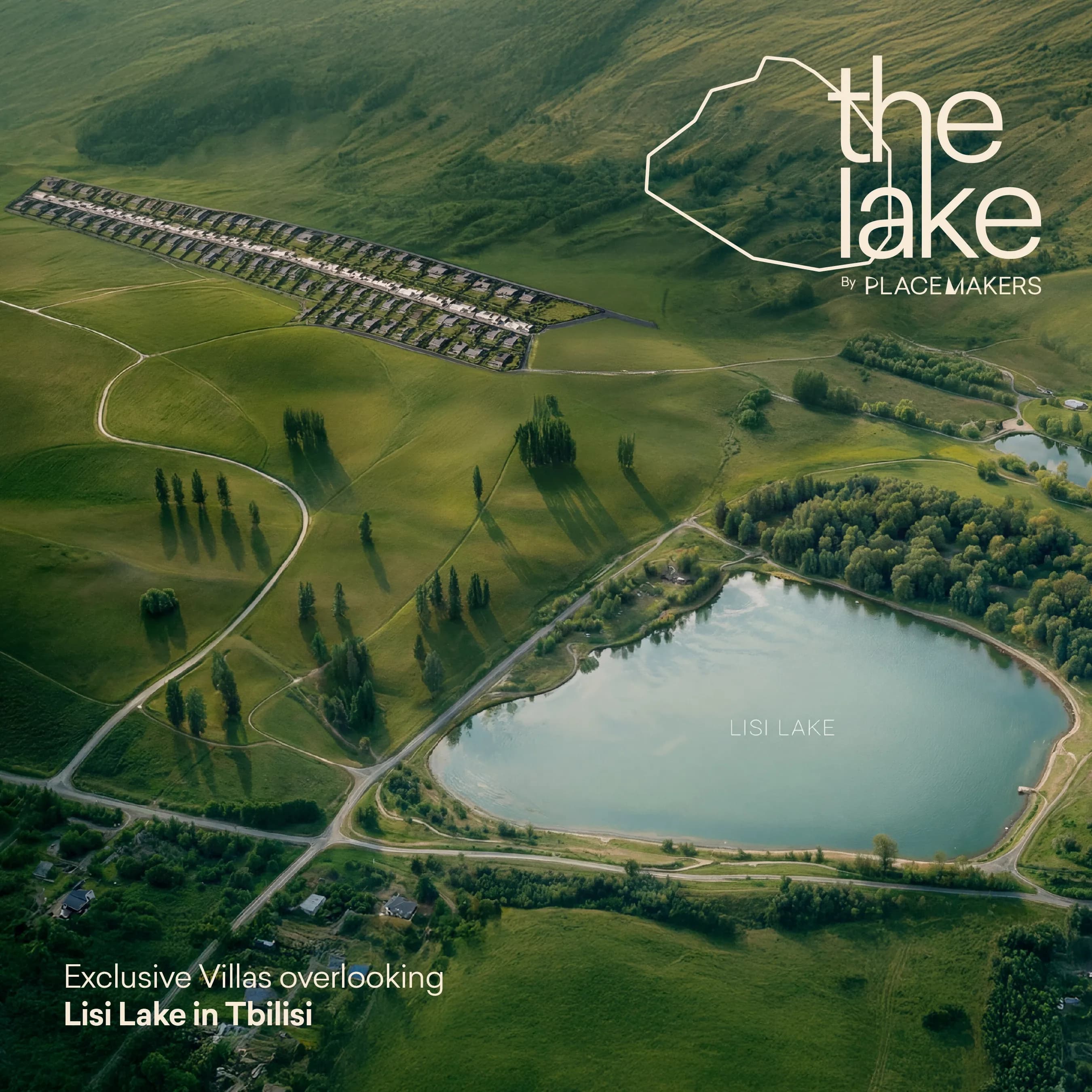
If the version of villa living described above appeals - space and forest without cutting yourself off from the city - it is worth looking at what a master-planned community on Lisi Lake actually offers, because it answers several of the trade-offs this guide has raised.
The setting. The Lake by Placemakers is planned as 90 villas and private houses across 14 hectares on the slopes above Lisi Lake, roughly 7 km from the centre of Tbilisi. That distance is the point: close enough that the city remains part of daily life, high enough that the summer heat and valley air of central Tbilisi largely stay behind you.
The homes. Villas are planned at 500–800 m² and private houses at 200–400 m² - a range that covers both a substantial family house and something closer to an estate. The first phase is being designed by Georgian architect Vakhtang Visotsky. For context against the earlier sections of this guide: this is space that does not exist in Vake or central Saburtalo at any price, and it comes with the garden and outdoor living that hillside plots make possible. You can see the homes and plots on the interactive map or browse the gallery.
The Lakehouse. The community's planned social centre is the Lakehouse, designed by the Norwegian architecture firm Snøhetta and developed with the hospitality operator Salt. Its concept draws on the courtyards of old Tbilisi and the organic lines of the lake, and it is planned to bring together restaurants and a bar and kitchen, a pool, spa and wellness facilities, fitness, and workspaces under one roof.
This addresses the most common objection to hillside living raised earlier in this guide - that you trade a neighbourhood for a retreat. A shared social building is a deliberate attempt to keep both: somewhere to eat, train, work and meet people without driving into the city for every one of them, alongside resident services and an ongoing programme of events.
What it solves. Read against the practical realities section above, a master-planned community resolves several of the recurring difficulties of buying an individual Tbilisi house: roads, drainage, utilities and landscaping are coordinated from the outset rather than negotiated plot by plot; construction quality is consistent rather than variable; the common realm is professionally managed; and winter access is a designed part of the infrastructure rather than an inherited problem.
Status and timeline. The project represents a stated investment of around USD 50 million. The first infrastructure phase is targeted for completion in spring 2026, with residents expected from 2029. As with any development at this stage, these are the developer's stated plans rather than completed facts, and anyone considering a purchase should confirm current status directly.
Frequently asked questions
Are there villas in Tbilisi, or is it mostly apartments?
Tbilisi is predominantly an apartment city, but a substantial stock of villas and private houses exists, concentrated in specific hillside and lakeside districts rather than spread evenly across the city.
Which areas of Tbilisi have the most villas and private houses?
The main concentrations are Zemo Vake and Bagebi, upper Saburtalo, Lisi Lake and Upper Lisi, Tskneti, Kojori, the Turtle Lake and Mtatsminda slopes, Krtsanisi, and Digomi.
Where do expats and international families live in Tbilisi?
Single arrivals and shorter-term residents tend toward apartments in Vake, Vera and Saburtalo. Families staying longer more often move toward houses at Lisi Lake or in the hillside districts, usually guided by school location.
Is Tbilisi safe to live in?
Yes. Tbilisi is consistently regarded as one of the safer capitals in the region, with low levels of violent crime - one reason the more secluded hillside districts are practical places to live.
Why do people build villas on Tbilisi's hills?
Cooler summer air, better air quality, forest, views, and more space than the valley floor allows. The pattern dates back to the nineteenth century, when the city's residents left for the hills each summer.
What is the climate like in Tbilisi's hillside villa areas?
The valley is hot in summer, commonly in the low-to-mid thirties Celsius, with a record of 40.6°C set in July 2021. Hillside areas are markedly cooler - Kojori averages around 17°C in August. Winters are continental, with snow and occasionally difficult hillside road access.
Can foreigners own a house in Georgia?
Foreign nationals can generally own residential property in Georgia, while agricultural land is treated differently. The full process, costs and requirements are covered in our Georgian-language guide to buying a villa in Tbilisi.
What international schools are near Tbilisi's villa districts?
Several operate in the city, including QSI International School of Tbilisi, founded in 1995, and the British-Georgian Academy, founded in 2006, which offers Cambridge International and International Baccalaureate programmes.
If villa living by the water is the version of Tbilisi you are weighing, you can explore the lifestyle at The Lake or get in touch with any questions about the area.